Documentation Standards & Best Practices
The Comprehensive Whitepaper for System Engineers
note refine
verbThe technical process of transforming unstructured data (logs, shorthand, brain dumps) into standardized, compliant documentation using Natural Language Processing (NLP). This aligns with ISO 9001 quality management standards for record-keeping and is a cornerstone of modern DevOps practices.
System Architecture
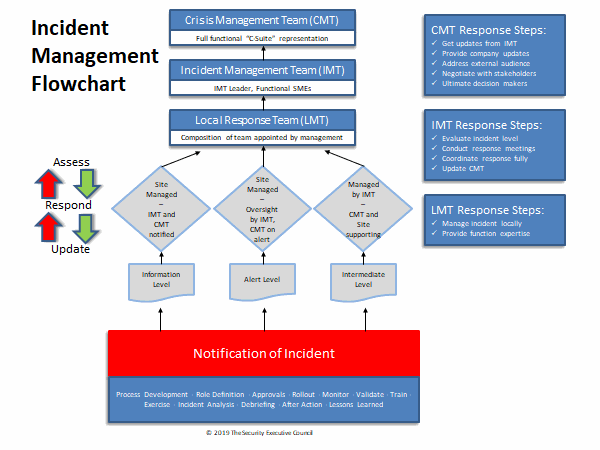
Figure 1: High-Level Data Processing Flow using Generative AI
Curated Video Library
We have curated the most authoritative talks from Google, IBM, and TED regarding technical communication. These resources are essential for any Senior Engineer.
What is SRE?
Google's official breakdown of Site Reliability Engineering and why logging matters.
Watch on YouTube ↗SLIs, SLOs, SLAs, oh my!
Understanding the metrics that define system uptime and reliability reports.
Watch on YouTube ↗What is ITIL 4?
A guide to the Information Technology Infrastructure Library framework.
Watch on YouTube ↗Tech Writing for Devs
The official course on how to write clear, concise engineering documentation.
Watch on YouTube ↗Markdown Crash Course
Learn the syntax used by GitHub and NoteRefiner for formatting code blocks.
Watch on YouTube ↗SQL Injection
Why validating and documenting database inputs is critical for security.
Watch on YouTube ↗10 Ways to Have a Better Conversation
Communication skills are the #1 predictor of engineering career growth.
Watch on YouTube ↗Start with Why
Understanding the "Why" behind a technical incident is key to Root Cause Analysis.
Watch on YouTube ↗Psychological Safety
Why "Blameless Post-Mortems" are essential for a healthy engineering culture.
Watch on YouTube ↗Chapter 1: The Evolution of Technical Writing
The history of technical documentation mirrors the history of engineering itself. In the early days of computing (the Mainframe Era), documentation was often written by dedicated scribes on physical paper. As we moved into the Agile era, the philosophy shifted to "Working software over comprehensive documentation" (Agile Manifesto, 2001).
However, the "No Docs" movement created a massive technical debt crisis. In the modern DevOps era (2015-Present), we have realized that Communication is Infrastructure. Code that is not documented is code that cannot be maintained. NoteRefiner represents the next evolutionary step: Documentation as Code, generated automatically by AI to keep pace with rapid CI/CD deployment cycles.
Chapter 2: Cognitive Load Theory in Engineering
John Sweller's Cognitive Load Theory (1988) explains why bad notes are dangerous. The human brain has a limited "Working Memory." When an engineer reads a messy log like "server broken maybe db issue idk," their brain wastes energy decoding the text instead of solving the problem.
This is called "Extraneous Cognitive Load." NoteRefiner eliminates this load. By formatting the text into a standard Problem > Analysis > Solution structure, the tool reduces mental friction, allowing the engineer to enter a "Flow State" faster.
Miller's Law Application
Miller's Law states the average person can only hold 7 (plus or minus 2) items in their working memory.
- Messy Note: Contains 20+ unrelated facts scattered randomly. (Overloads memory)
- Refined Note: Groups facts into 3 clear headers: Issue, Logs, Fix. (Fits in memory)
Chapter 3: Case Studies of Failure
History is filled with expensive disasters caused not by bad code, but by bad communication. These stories highlight why tools like NoteRefiner are critical for mission-critical environments.
1. The Mars Climate Orbiter ($327M Loss)
September 1999
NASA lost a $327 million spacecraft because of a simple documentation error. One engineering team used Metric units (Newtons) while another used Imperial units (Pounds-force) in their software specifications.
The Lesson: Standardized formats save lives (and millions of dollars). Ambiguity in units or error codes is unacceptable in engineering.
2. The Knight Capital Glitch ($440M Loss)
August 2012
In just 45 minutes, Knight Capital Group lost $440 million due to a failed deployment. An engineer forgot to copy new code to one of the eight servers because the deployment manual was outdated and unstructured.
The Lesson: Checklists and clear "Steps to Reproduce" are not optional. They must be generated accurately every time.
3. The AWS S3 Outage (Typo Disaster)
February 2017
A massive portion of the internet went down because an Amazon engineer made a typo while entering a command to debug a billing system. He intended to remove a small number of servers but accidentally removed a massive set of foundational systems.
The Lesson: Precise documentation of commands and "Double Check" protocols are vital. NoteRefiner helps isolate commands in code blocks to prevent copy-paste errors.
Chapter 4: ITIL Framework Compliance
The Information Technology Infrastructure Library (ITIL) is the global standard for IT Service Management (ITSM). NoteRefiner is designed to help organizations adhere to ITIL v4 practices, specifically in the Service Operation lifecycle.
Incident Management
ITIL requires strict recording of incidents. Our tool ensures every ticket includes a categorization, prioritization, and resolution timestamp.
Problem Management
Distinguishing between an "Incident" (one-time event) and a "Problem" (root cause) requires clear notes. We help document the Known Error Database (KEDB).
Knowledge Management
The goal of ITIL is to shift knowledge "Left"—making it available to Level 1 support. Our KB Article mode creates artifacts for the Service Desk.
Chapter 5: The ROI of Documentation
of a knowledge worker's week is spent just searching for information and reading internal docs (Source: McKinsey).
is the estimated annual cost per employee due to productivity loss from "Knowledge Barriers" and poor documentation.
of IT incidents are caused by Change Management errors, often due to poor handover notes (Source: Gartner).
Chapter 6: Writing as Empathy
Software engineering is often seen as a solitary pursuit, but documentation is an act of empathy. When you write a clear, concise log, you are being kind to:
- Your Future Self: Who will be woken up at 3 AM six months from now to fix this exact same bug.
- Your Teammates: Who won't have to disturb you on your vacation to ask where the config file is.
- Your Users: Who get their service restored faster because the root cause was identified quickly.
NoteRefiner is not just a formatting tool; it is an empathy engine for technical teams.
Career Growth Resources
Master the fundamentals of IT troubleshooting and standard documentation practices.
Learn the cloud terminology required for accurate server logging and reporting.
Understand the networking protocols (TCP/IP, DNS) cited in technical logs.
Frequently Asked Questions
How accurate is the AI refinement?
NoteRefiner uses advanced Generative AI models (Gemini 2.5 Flash / Gemma 3) which are specifically tuned for code and technical language.
Does this work for coding languages?
Yes. If you paste a snippet of Python or SQL error logs, the AI will recognize the code and format it into a Markdown code block.
Is this compliant with Data Privacy?
Yes. We do not store your input text on our servers. The text is processed in real-time and returned to your browser.